My entire life, they made sure I knew. Every scraped knee, every forgotten birthday, every Christmas morning where my presents felt a little less special, a little less theirs. “You’re not really one of us,” my older brother would sneer, his voice a low growl designed to mimic my father’s when he was truly angry. My sister would join in, her sweet voice turning saccharine, “Remember, you’re adopted. You have your own family somewhere else.”
The cousins, oh the cousins. They were the worst. A pack of wolves, always circling, always sniffing out weakness. They’d invent cruel games, like “Find Your Real Parents,” which involved me wandering the neighborhood, knocking on strangers’ doors while they watched from a distance, giggling. It sounds childish now, but imagine being seven years old, desperate for acceptance, and having your very identity weaponized against you, day in and day out. It was a constant, sharp ache in my chest. A feeling of being a placeholder, never truly belonging.
A bride holding a bouquet of flowers | Source: Unsplash
My parents, bless their hearts, tried. They’d tell me how special I was, how chosen. But their words, meant to soothe, felt like a thin blanket against a winter storm. They never truly understood the depth of the torment. Or maybe they just couldn’t fix it. “They’re just being silly,” my mother would say, stroking my hair, “They don’t mean it.” But they did mean it. Every single hurtful word was laced with intent, designed to remind me that I was an outsider, a charity case, an asterisk in their otherwise perfect family tree.
I grew up with a chip on my shoulder, heavy and sharp. I learned to fight back, verbally at least. I developed a razor-sharp wit, a shield against their barbs. But underneath, the wound festered. I dreamed of the day I’d find my real family, the ones who wouldn’t look at me with pity or disdain, the ones who would truly love me. I imagined showing up to a family gathering, arm-in-arm with newfound biological relatives, proving to my adopted family and especially to my bullies, that I was wanted. I was loved. I would have the last laugh.
A woman using her phone | Source: Pexels
The yearning for answers intensified with age. My adoptive parents were always vague about my origins. “Your biological mother loved you very much but couldn’t care for you,” was the standard line. No names, no locations, no stories. Just a wall of silence. It fueled my quiet defiance. I spent hours online, searching adoption registries, support groups, anything. But it was a shot in the dark, a needle in a haystack.
Then, the ancestry kits became popular. It felt like a sign. A chance. I ordered one, carefully, secretly. I didn’t tell anyone, especially not my “siblings” or “cousins.” This was my quest, my secret weapon. The day the small box arrived, I felt a tremor of anticipation, a mixture of hope and fear. I followed the instructions, spit into the tube, sealed it, and sent it off. The waiting was agony. Every notification from my email felt like a jolt.
A couple holding hands | Source: Unsplash
Weeks later, the email came. “Your DNA results are ready!” My heart hammered against my ribs. I clicked the link, fingers trembling. I scrolled past the ethnicity estimates, which were interesting but not what I was looking for. I went straight to the “DNA Relatives” section. And there it was. A list.
My eyes scanned the names, mostly distant cousins, second, third. My breath hitched as I saw a closer match. “First Cousin.” The picture attached was a generic avatar. I clicked on the profile, desperate for a name, an age, anything. And then I saw it. The name. My stomach plummeted. I reread it, then reread it again, my vision blurring.
A stressed man | Source: Midjourney
It was their name. The ringleader of the cousins. The one who had spearheaded most of the bullying. The one who had made my childhood a living hell with her taunts about my adoption, about me not belonging. She was listed as my biological first cousin. How could this be? I thought. A mistake? My head spun.
I delved deeper, clicked on “Shared Matches.” And that’s when the entire world tilted on its axis. My “siblings” were listed too. Not as siblings. No. They were listed as half-aunts and half-uncles. And my “parents”? They weren’t listed as parents. They were listed as my biological grandparents.
NO.
My mind raced, trying to put the pieces together, but they didn’t fit. They couldn’t. Unless… unless everything I’d ever been told was a lie. A carefully constructed fabrication.
A couple holding an ultrasound scan image | Source: Unsplash
I stared at the screen, tears streaming down my face. The “cousin” who had relentlessly mocked me for being adopted, who had gleefully reminded me I was an outsider, she was my biological mother. My mother. And my “parents” were my grandparents. The family I thought had taken me in out of charity, out of kindness, had instead covered up a scandal. My entire life, I had been raised believing I was an outsider, when in reality, I was their deepest, darkest secret.
The “last laugh” I had always dreamed of felt like a phantom limb, an appendage that had been violently ripped away. There was no triumph. No vindication. Only a profound, suffocating sorrow. The bullies hadn’t just been cruel, they had been unwitting accomplices in a devastating lie, taunting their own flesh and blood, their own child, their own nephew, their own niece. And my grandparents, who claimed to love me, had let me suffer for decades, all to protect the family name.
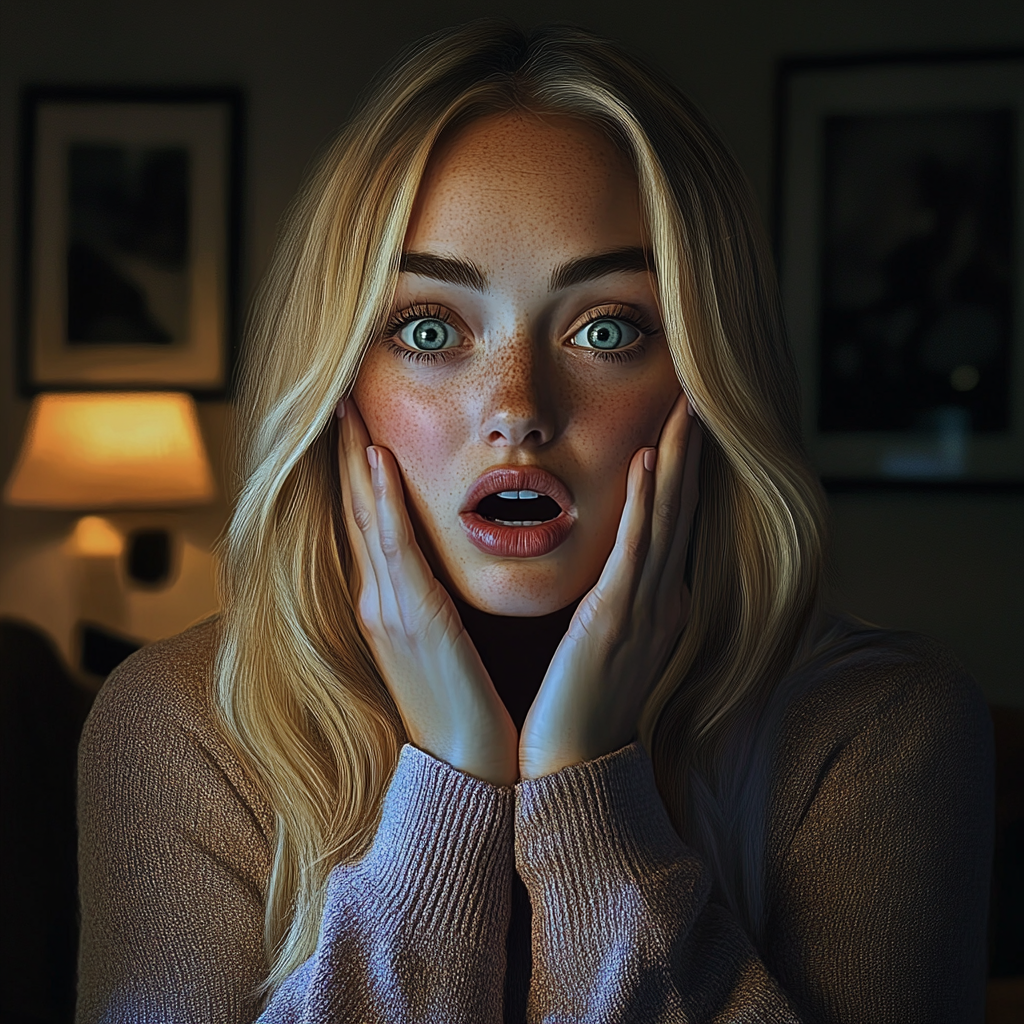
A shaken woman | Source: Midjourney
I wasn’t adopted from some distant, unknown family. I was adopted into the family I was already a part of, hidden in plain sight. The ones who told me I didn’t belong, were the very ones who had made sure I never truly could. The pain of being an outsider now felt like a cruel joke. I was never an outsider. I was trapped within their lie. And the last laugh? It was on me. It was always on me.