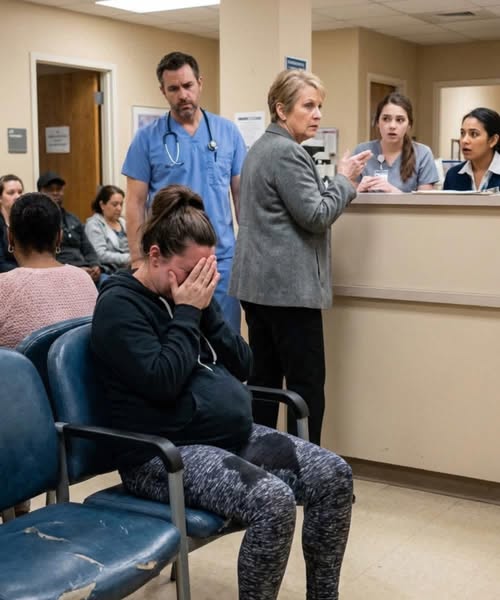
 The Day No One Believed My PainThe Pain That Shouldn’t Have Been IgnoredI was thirty-two weeks pregnant when the pain started.It wasn’t the dull ache I’d read about in pregnancy forums. It was sharp, violent—strong enough to bend me over the kitchen sink while I was washing a coffee mug.My husband, Ryan, was out of town for work in Nashville.His mother, Gail, had been staying with me so I wouldn’t be alone that far along in my pregnancy.By the time she drove me to Brookside Regional Hospital in Indianapolis, sweat soaked through my sweater and my hands were gripping the car door so tightly my fingers hurt.Something felt terribly wrong.Not in a way I could explain yet.But my body knew.

A young man standing in a kitchen wearing a navy blue sweatshirt | Source: Midjourney
The Waiting Room
When Pain Meets Indifference
At the hospital front desk, I leaned against the counter with one hand under my belly.
“Please,” I said quietly. “I’m having severe pain. I’m thirty-two weeks pregnant.”
The receptionist asked for my insurance card.
Then she looked past me at Gail.
“Is the father here?”
“No,” I answered. “He’s out of town.”
Gail gave a dry little laugh.
“Oh, she gets worked up over everything,” she said. “She’s sensitive.”
I stared at her.
“I’m not worked up,” I said. “I’m in pain.”
The receptionist’s expression shifted into that polite, tired look people wear when they’ve already decided you’re dramatic but not urgent.
She handed me a clipboard.
“Fill these out and take a seat. Labor and delivery is backed up.”
I could barely hold the pen.
The Dangerous Dismissal
“She Has a Low Pain Tolerance”
The cramps kept getting worse.
They weren’t rhythmic like contractions. They were deep, chaotic, and wrong.
“I think something is happening,” I whispered to Gail.
“If you act hysterical,” she snapped, “they’ll take you even less seriously.”
A nurse walked by with paperwork. I told her I thought my water might be leaking.
Before she could respond, Gail jumped in.
“She’s been Googling symptoms for months,” she said. “Every cramp means tragedy to her.”
The nurse nodded slightly and moved on.
Then Gail leaned toward the desk and said loudly enough for the entire waiting room to hear:
“She has a very low pain tolerance.”
The Longest Hour of My Life
Waiting While Something Went Wrong
Forty minutes passed.
Then fifty.
Then more than an hour.
By then I was shaking so badly the woman sitting across from me offered me her bottle of water.
I tried to thank her, but my voice wouldn’t come out properly.
At one point I stood up to walk back to the desk.
A bolt of pain dropped me to one knee.
“Get up,” Gail hissed. “You’re embarrassing yourself.”
The Doctor Who Finally Looked
One Question That Changed Everything
The waiting room doors opened and a young doctor walked through holding a chart.
He stopped when he saw me.
Folded over beside the plastic chairs.
His eyes moved quickly—from my face… to the wet blood on my leggings… then to the front desk.
And the first thing he said was:
“Why is she still out here?”
A determined woman at an office reception desk | Source: Midjourney
Everything Changed in Seconds
The Moment Someone Took Me Seriously
The doctor didn’t speak quietly.
He raised his voice.
The receptionist jumped to her feet. A nurse rushed over with a wheelchair.
Suddenly everything was urgent.
Gail immediately changed her tone.
“I kept telling her to calm down—”
“Ma’am,” the doctor said sharply, “stop talking.”
I had never loved a stranger more.
The Race Upstairs
When the Truth Started Appearing
The ride upstairs blurred together.
Pain.
Questions.

A lawyer in a navy suit | Source: Midjourney
Bright lights.
A nurse named Jenna kept asking things gently.
How far along was I?
When had the pain started?
Was there bleeding?
Was the baby moving?
When she asked about the last movement, I froze.
I couldn’t remember.
That was when the real terror arrived.
The Silence No Parent Wants to Hear
The Monitor That Found Nothing
The young doctor introduced himself as Dr. Mason Reed.
He ordered tests immediately—monitoring, blood work, ultrasound.
Jenna strapped the fetal monitor around my stomach.
The room stayed too quiet.
She adjusted it.
Pressed harder.
Moved it again.
Nothing.
“Try ultrasound,” Dr. Reed said quietly.
The Words That Broke Everything
“I’m So Sorry, Emily”

A young man standing with his arms crossed | Source: Midjourney
The ultrasound technician moved the wand slowly across my stomach.
Cold gel.
Dim lights.
Gray shapes on the screen.
But no one spoke.
Finally Dr. Reed sat beside me.
His voice was barely above a whisper.
“I’m so sorry, Emily.”
“There’s no heartbeat.”
Two Hours Too Long
The Question That Haunted the Room
I don’t clearly remember screaming.
I remember the shape of it.
Jenna holding my shoulders.
My body shaking uncontrollably.
Gail saying, “That can’t be right,” as if disbelief somehow erased what had happened.
Then Dr. Reed asked a quiet question.
“How long was she in the waiting room?”
No one answered.
But the record showed it clearly.
Two hours and eleven minutes.
Too long for severe pain.
Too long for bleeding.
Too long for a thirty-two-week pregnancy.
Too long for a baby who might have had a chance.
The Phone Call That Hurt the Most
Ryan’s First Question
Ryan called while I was still in the hospital.
I answered on speaker because my hands were shaking too badly.
“Our baby is gone,” I whispered.
There was silence on the line.
Then Ryan asked the first question.
“What did you do?”
Not:
Are you okay?
What happened?
Just blame.
That was the moment I realized I hadn’t only lost my son that day.
I had lost the illusion that his family would ever let me grieve without accusing me first.
The Truth Starts Breaking Through
When the Story Fell Apart
Ryan returned from Nashville the next morning.
But he arrived carrying his mother’s version of the story.
“She said you were panicking in the waiting room,” he told me.
“I was bleeding,” I answered.
A hospital review began quickly.
Dr. Reed had documented everything.
Witnesses from the waiting room confirmed hearing Gail repeatedly dismiss my pain.
One patient even reported Gail saying:
“She’s always dramatic.”
Gail called those statements slander.
The hospital called them relevant evidence.
Fighting for the Truth
Refusing to Stay Silent
Ryan wanted to keep everything quiet.
I wanted the truth recorded.
So I wrote everything down.
The pain.
The waiting room.
The stranger who gave me water.
Gail telling me not to embarrass her.
Ryan asking what I had done.
I filed a formal complaint.
I met with a lawyer.
And I stopped taking Gail’s calls completely.
The Final Breaking Point
When His Family Turned on Me
Then Ryan’s family started whispering something cruel.
They said I had always been too fragile to carry a baby.
It nearly broke me.
Not because it was true.
But because it was so easy for them to say.
If Noah’s death wasn’t my fault… then it belonged to their neglect.
And people will say almost anything to avoid facing that truth.
Walking Away
The Marriage That Couldn’t Survive
When I told Ryan I was leaving, he cried.
“I lost my son too,” he said.
“Yes,” I answered.
“But I lost him while begging for help.”
“You lost him while defending the people who made sure no one listened.”
There was no coming back from that.
The Lesson I’ll Never Forget
When Your Body Knows the Truth
I still think about Noah every day.
About the nursery drawers I had already organized.
About the tiny pajamas folded on the shelf.
But one thought stays with me more than anything else.
A room full of medical professionals ignored me—until one doctor finally looked with his own eyes instead of trusting someone else’s judgment.
So if there is one lesson I carry forward, it’s this:
Never let someone else narrate your pain when your body knows the truth.
Not a mother-in-law.
Not a husband.
Not a tired receptionist.
Not anyone.